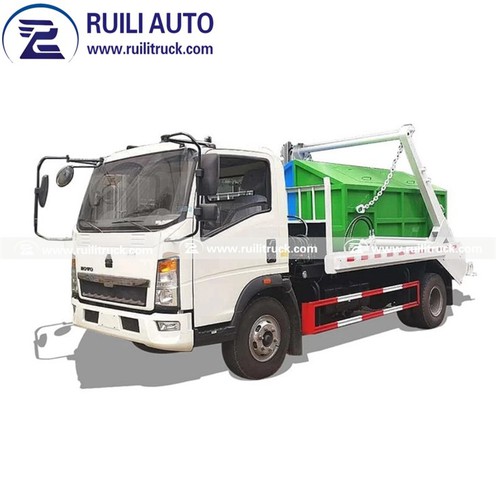
Swing-arm garbage trucks, a specialized category of waste management vehicles, have become a staple in municipal sanitation, commercial waste collection, and industrial waste handling. Their design centers on a hydraulic swing arm mechanism that streamlines loading, unloading, and transportation-offering distinct advantages over traditional garbage trucks. Below is a detailed analysis of their core benefits, grounded in their structural features and practical application scenarios.
1. High Operational Efficiency: Fast Loading & Unloading
The most prominent advantage of swing-arm garbage trucks lies in their efficient waste handling, driven by advanced hydraulic systems:
Rapid Cycle Time: Equipped with optimized hydraulic lifting mechanisms and sprocket transmission systems, these trucks complete a full load-unload cycle in just 60 seconds. This drastically reduces the time spent at each collection point, enabling operators to cover more locations in a single shift.
Simplified Operation: The hydraulic swing arm (controlled via in-cab or external panels) eliminates the need for manual lifting or multiple steps. Operators can easily hook, lift, and empty waste containers without leaving the vehicle, minimizing physical labor and human error.
Reduced Collection Frequency: Models with large capacities (ranging from 4 cubic meters for compact communities to 20 cubic meters for industrial sites) can carry substantial waste volumes. This cuts down on the number of trips required to transport waste to disposal facilities, saving time and fuel.
2. Cost-Effectiveness: Multiple Bins, One Truck
Swing-arm garbage trucks offer significant cost savings for waste management operations through their flexible container-compatible design:
Multi-Bin Compatibility: A single truck can work with multiple independent waste containers (skips or bins) across different locations. After emptying one container, the truck can proceed to the next, eliminating the need to carry a dedicated bin for each collection stop.
Lower Infrastructure Costs: Municipalities or enterprises only need to invest in stationary waste containers instead of equipping each collection point with a dedicated truck. This reduces upfront equipment costs and simplifies maintenance, as containers are easier to repair or replace than full vehicles.
Reduced Labor Requirements: The automated hydraulic system reduces the need for additional personnel to assist with loading or unloading. A single operator can manage the entire collection process, lowering labor expenses over time.
3. Strong Adaptability: Versatile for Diverse Scenarios
These trucks are engineered to handle a wide range of waste types and operating environments, making them highly versatile:
Waste Type Compatibility: They efficiently manage municipal solid waste, construction debris, industrial waste, and even chemical waste (with specialized sealed containers). Their robust structure-including swing arms made of high-strength steel (No. 10 and No. 12 grades)-withstands the abrasion and weight of different waste materials.
Environmental Flexibility: Compact models (e.g., mini swing-arm trucks with overall dimensions of 5970×2000×2900mm) navigate narrow residential streets and tight urban spaces with ease. Heavy-duty variants (10–15 ton payloads) excel in industrial sites or construction zones, where large volumes of waste are generated.
Climate and Terrain Resilience: Equipped with features like air brakes, ABS, and durable tires (e.g., 7.00-16 specifications), they maintain stability on various road conditions-from paved city streets to uneven construction sites. Their 4×2 traction system ensures reliable performance in most operational settings.
4. Easy Maintenance & Longevity
Swing-arm garbage trucks are designed with simplicity and durability in mind, reducing long-term operational costs:
Simple Structure: The core components-hydraulic system, swing arm, and container attachment mechanism-have minimal moving parts. This simplifies maintenance, as operators can easily inspect, clean, or repair key parts without complex tools.
Durable Materials: The swing arm, outriggers, and platform are constructed from high-strength steel, resisting corrosion and wear from frequent use. Many models also feature anti-rust treatments (e.g., electrophoretic coating) to extend service life.
Standardized Parts: Most components (such as hydraulic pumps and control systems) follow industry standards, making replacement parts readily available. This minimizes downtime when repairs are needed.
5. Environmental Friendliness
Modern swing-arm garbage trucks align with global emission standards, offering eco-friendly waste management solutions:
Compliant Emissions: Many models meet Euro II or Euro V emission standards, reducing harmful pollutants like nitrogen oxides and particulate matter compared to older vehicles.
Reduced Spillage: The sealed container design and secure attachment mechanism prevent waste leakage during transportation, minimizing environmental contamination. Flexible sealing doors further enhance this advantage by containing odors and preventing debris from scattering.
In summary, swing-arm garbage trucks combine efficiency, cost-effectiveness, versatility, and durability-making them an ideal choice for modern waste management. Their ability to adapt to diverse scenarios, simplify operations, and reduce long-term costs has solidified their role in municipal, commercial, and industrial settings worldwide. Whether for small-scale residential collection or large-scale industrial waste handling, these trucks deliver reliable performance that meets the evolving needs of waste management operations.
Swing-arm garbage trucks